DSTAIR
Diagnostic System for Transparency and Institutional Reform
We quantify the legitimacy of governance using advanced social metrics.

The Fight Against
Corruption.
Corruption is treated as the use of public resources for private gain. But it is better understood as a betrayal of the public confidence invested in individuals with access to public resources.
Corrupt practices are found in all branches of government, in business, and even within civil society. The broader consequences are a slowing down, or even reversal, of development goals.
Within any given sphere, corruption is largely the outcome of a breakdown in legitimate or just rules and practices (), leading to unfair or arbitrary institutions.
Institutions
A common way to define institutions is to treat them simply as organisations that tend to persist over time. A stricter definition is to treat them as the noun form of the verb root: "to institute," i.e., to put into practice.
The following definition holds:
This characterisation is useful for understanding the circumstances under which corrupt practices can flourish.
Intelligent
Decision Support
DSTAIR is a web-based decision support system that provides a platform for analyzing the effectiveness of current institutions by gauging the legitimacy of different spheres of governance within a given country.
How DSTAIR is Different
Granular Analysis
Instead of making an overall judgment about a country, DSTAIR looks for institutional weaknesses in each of the many core spheres of the state and society: the constitution, courts, legislature, the executive, administration, political parties, media, the economy, and civil society.
User Driven
It assumes that both the formal rules and informal practices in these spheres are important determinants of their overall legitimacy. DSTAIR is user driven; the program prompts users to make their own assessment about which particular institutions are legitimate and which are most in need of reform.
Comparative Logic
Policy recommendations which utilize legitimate institutions are identified by tabulating the user's assessments. The flexibility of the DSTAIR allows users to compare their own judgment with that of others, and to review alternative recommendations until they find what matches their needs.
The Montesinos
Network
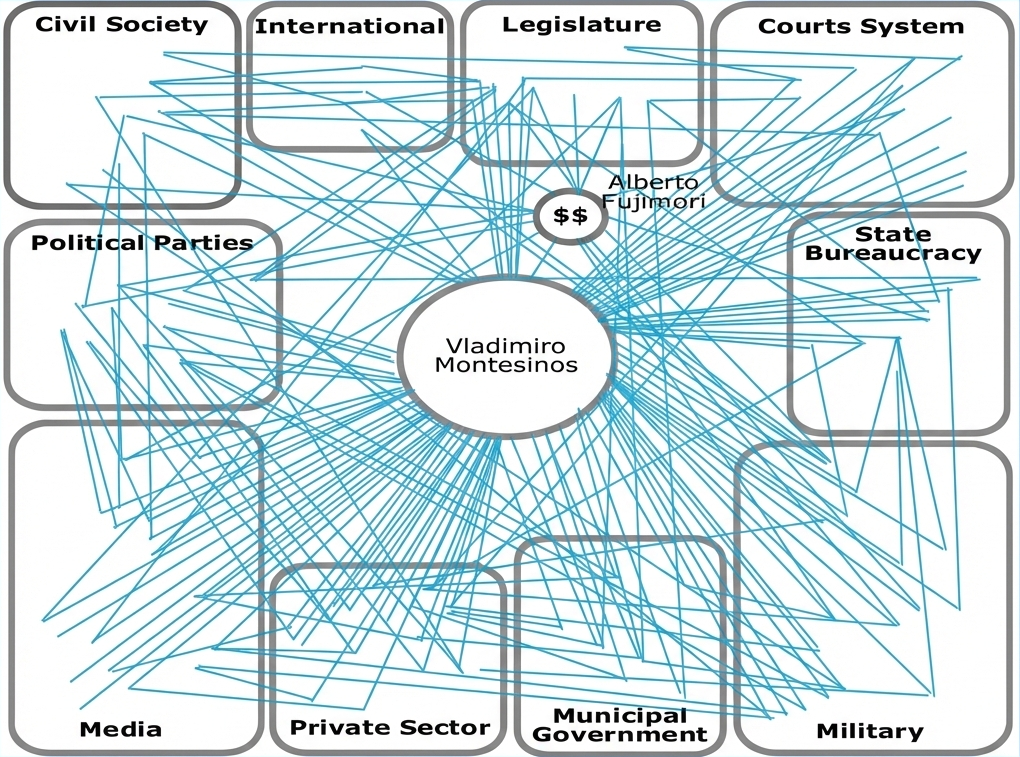
The Montesinos case illustrates how corruption networks can spread across a broad spectrum of the state and society, especially when fostered by institutional failings in multiple spheres. In Peru during the 1990's, intelligence service chief Vladimiro Montesinos tried to bribe anyone who could be useful to the then president, Alberto Fujimori.
But since he also videotaped all his meetings, investigators like Luis Moreno-Ocampo have been able to piece together a vast corruption network that involves individuals in virtually all spheres of the Peruvian polity and society.
That neither the courts nor the media were immune from involvement in this network meant that there were virtually no institutional safeguards left to protect the average Peruvian citizen. (Adapted from: World Bank Institute).